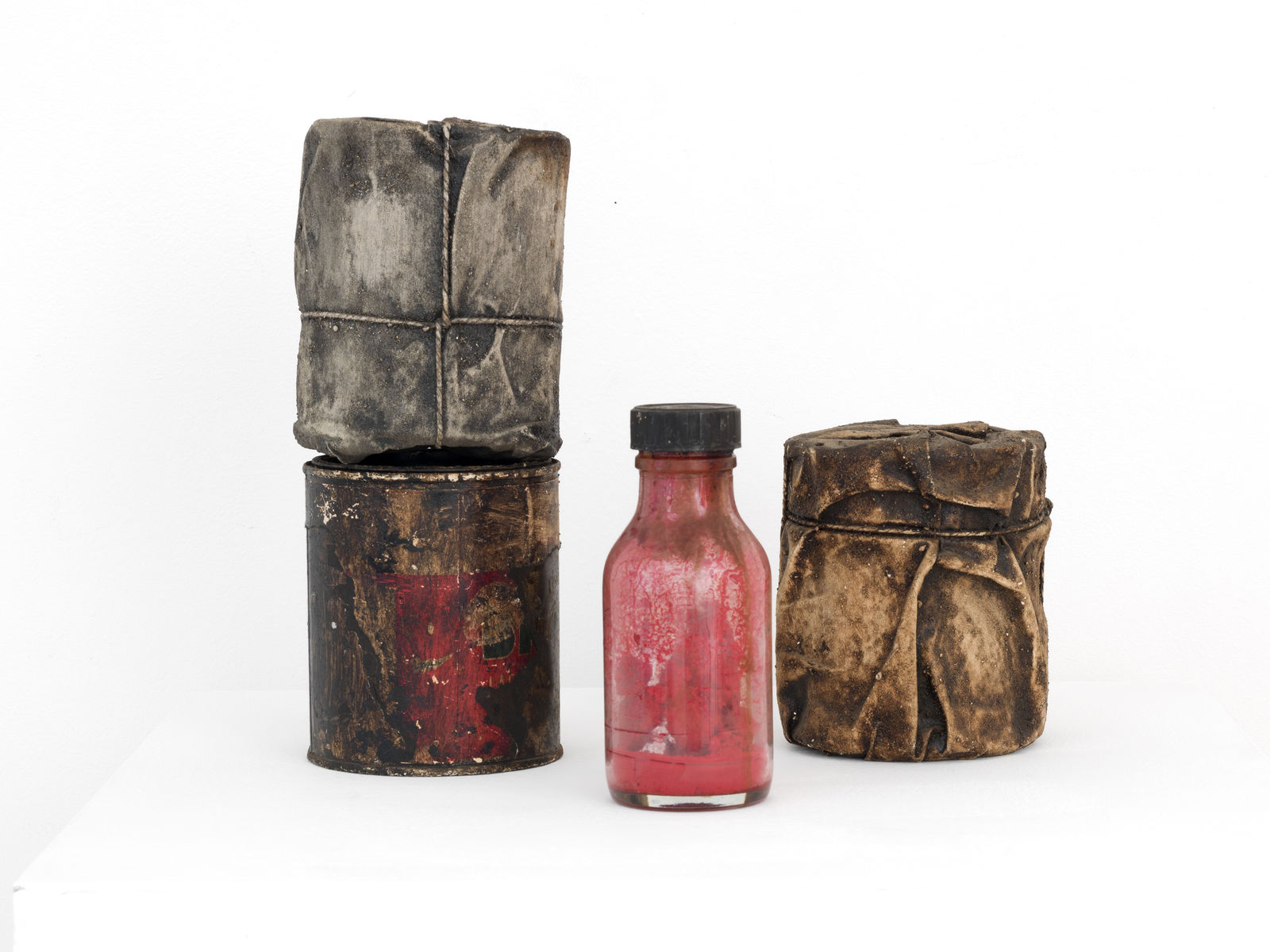
Christo Bulgarian / American, 1935-2020
unwrapped can: 10.8 x 10.2 x 10.2 cm
wrapped cans: 12.7 x 10.8 x 10.8 cm each
In March 1958, Christo arrived in Paris where he created his first wrapped cans. It started with a small, empty paint can, of which there were many lying around in his studio. Christo wrapped the insignificant object in resin-soaked canvas, tied it up and coated the result with a mixture of glue, varnish and sand and a thin layer of dark-black or brown lacquer.
If we consider the fact that Christo always contrasted his wrapped cans with versions with no wrapping, it soon becomes clear that he was interested not only in the concealment of the object but also in the comparative analysis of the three-dimensional qualities of different objects, surfaces and materials. He had the choice of either wrapping the cans or painting them. Others he left unchanged, so that the company name or at least parts of it could still be deciphered under the many blotches of paint.
The first of these ensembles was limited to only two cans, but soon whole groups appeared consisting of a variety of wrapped, painted and unaltered cans and bottles. It is important to point out that none of the works are mounted on a base, which implies that Christo did not explicitly prescribe the arrangement of the individual components. In reality, the cans, now scattered among collections, were once part of a large installation of wrapped, painted and unaltered cans, bottles and crates that Christo did between 1958 and 1960 and baptized Inventory. All the works were originally conceived to be presented in the corner of a room as an ensemble, roughly comparable to the household inventory that one piles in the corner of a room when one moves into a new house.
In addition to the fact that the work has been fragmented into its separate parts, there is the aggravating circumstance that only fragments of the many pieces still exist today. When Christo and Jeanne-Claude moved to New York in 1964 and were unable to pay the rent on their storeroom in Gentilly, a suburb of Paris, their landlord threw all the works in the garbage. The only reason that some of the cans, bottles and barrels survived is that Christo had several small studios and storage rooms at the time, among them a basement room attached to the apartment belonging to Jeanne-Claude's mother. It is believed, however, that the many crates, of which only a few black-and-white and color photos exist today, were all destroyed.
Excerpt from the book Christo and Jeanne-Claude: Early Works 1958-64 by Matthias Koddenberg, published in 2009). Text edited in 2021.