Leon Kossoff British, 1926-2019
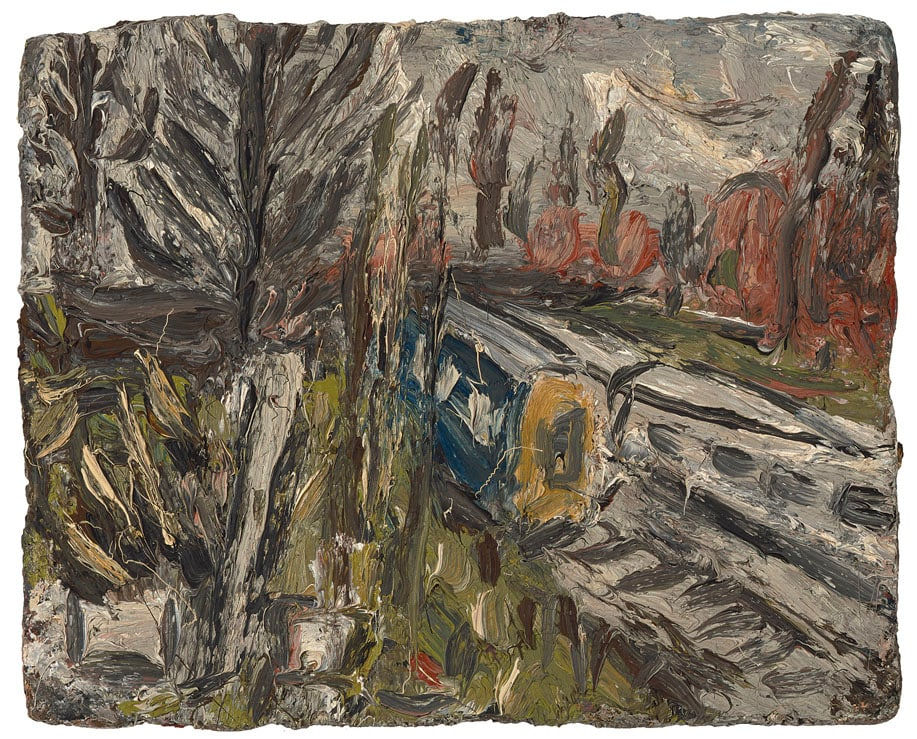
Between Kilburn and Willesden Green, Spring Afternoon, 1991
Oil on board
44.5 x 55.5 cm
Extract from Catalogue raisonné, P. 406 At the end of Kossoff’s garden in Willesden Green runs a broad railway cutting with three double tracks, operated by the Jubilee and Metropolitan...
Extract from Catalogue raisonné, P. 406
At the end of Kossoff’s garden in Willesden Green runs a broad railway cutting with three double tracks, operated by the Jubilee and Metropolitan tube lines, and the main-line Chiltern Railways, which plies between London Marylebone and Aylesbury. The large garden is planted with cherry and pear trees (the area was previously a fruit orchard), and a path of flagstone steps (laid by Kossoff in order to help his grandchildren see the trains) leads from the lawn to the garden fence, beyond which lies the cutting. A gouache painted in 1965, shortly after Kossoff and his family moved to the house, shows the garden with the railway cutting clearly visible, as the screen of trees Kossoff subsequently planted had not yet grown up (see fig. 68). In spring 1987, the artist’s oldest grandson, Alexander, then a toddler, was playing in the garden when he pointed over the fence and shouted, ‘Here comes the diesel!’ The cry became the title of a sequence of paintings that show the diesel train, with its yellow snout and blue livery, moving along tracks closest to the garden, with red-brick houses on the other side of the cutting appearing through a screen of poplars. Two wooden posts, remnants of an earlier fence, mark the stages of the train’s progress. On one of the further tracks, a silver Jubilee Line train races past in the opposite direction. This is the first of eighteen paintings of the trains at Willesden Green completed between 1987 and 1993. Such paintings as this, wrote the art critic Robert Hughes in Time magazine, ‘connect him [Kossoff] back to late Constable, with their flickering impasto, their palpable joy in light and freshness embodied in substance’ (R. Hughes 1990, p. 345).
At the end of Kossoff’s garden in Willesden Green runs a broad railway cutting with three double tracks, operated by the Jubilee and Metropolitan tube lines, and the main-line Chiltern Railways, which plies between London Marylebone and Aylesbury. The large garden is planted with cherry and pear trees (the area was previously a fruit orchard), and a path of flagstone steps (laid by Kossoff in order to help his grandchildren see the trains) leads from the lawn to the garden fence, beyond which lies the cutting. A gouache painted in 1965, shortly after Kossoff and his family moved to the house, shows the garden with the railway cutting clearly visible, as the screen of trees Kossoff subsequently planted had not yet grown up (see fig. 68). In spring 1987, the artist’s oldest grandson, Alexander, then a toddler, was playing in the garden when he pointed over the fence and shouted, ‘Here comes the diesel!’ The cry became the title of a sequence of paintings that show the diesel train, with its yellow snout and blue livery, moving along tracks closest to the garden, with red-brick houses on the other side of the cutting appearing through a screen of poplars. Two wooden posts, remnants of an earlier fence, mark the stages of the train’s progress. On one of the further tracks, a silver Jubilee Line train races past in the opposite direction. This is the first of eighteen paintings of the trains at Willesden Green completed between 1987 and 1993. Such paintings as this, wrote the art critic Robert Hughes in Time magazine, ‘connect him [Kossoff] back to late Constable, with their flickering impasto, their palpable joy in light and freshness embodied in substance’ (R. Hughes 1990, p. 345).